
Look behind most dryers and you will find one of three things: a crinkly foil or white vinyl accordion hose, a semi-rigid aluminum duct, or smooth rigid metal pipe. They are not interchangeable. Which one you have affects how much lint builds up, how easily the duct gets crushed, and whether the setup meets the building code. This guide compares foil, semi-rigid dryer duct and rigid metal dryer duct using what the CPSC, NFPA and the International Residential Code actually say.
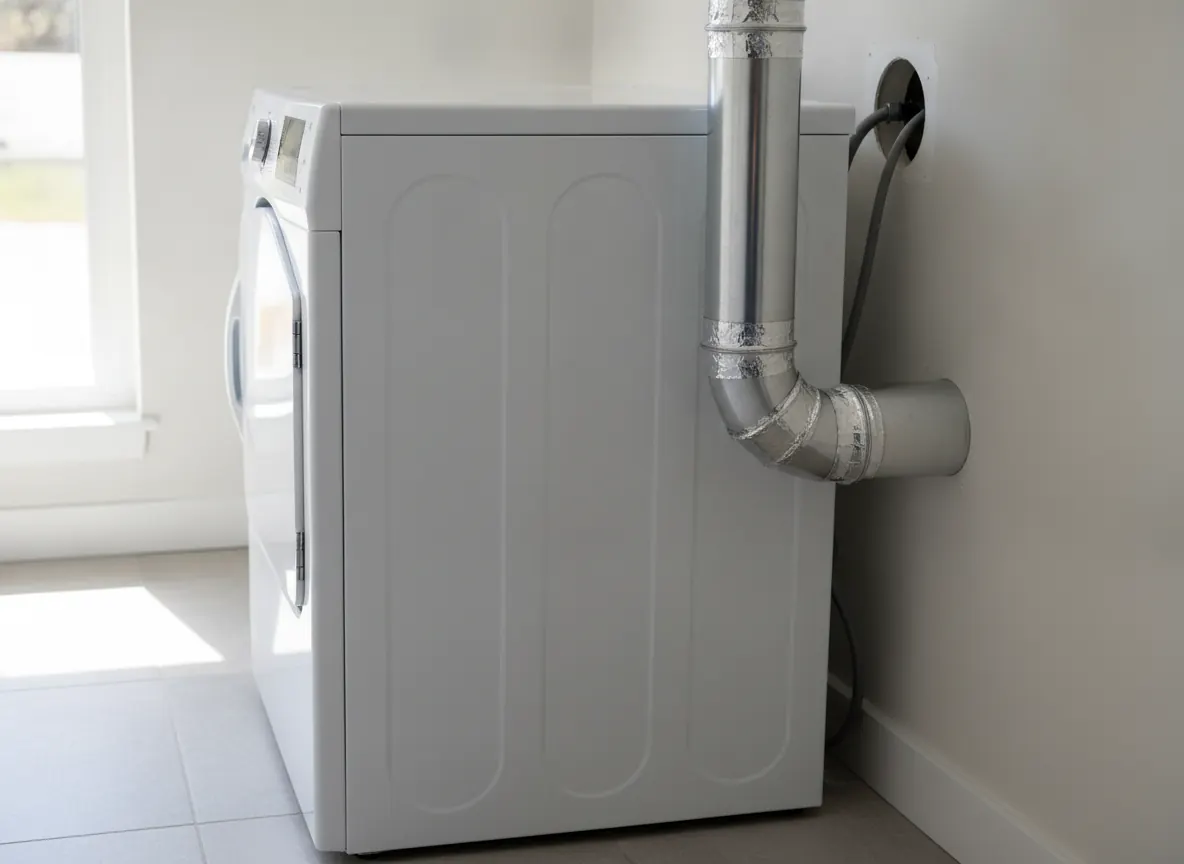
The two parts of every dryer vent
It helps to split the vent into two sections, because the rules differ:
- The transition duct is the short connector between the back of the dryer and the wall or floor. It has to bend, because the dryer moves.
- The exhaust duct is the fixed run inside walls, floors, ceilings or the attic that carries air to the outside termination.
Most problems people notice, such as a crushed hose, a disconnected joint or lint piling up behind the machine, happen in the transition duct. Most code problems hidden from view, like the wrong material or too many elbows, happen in the exhaust duct.
What CPSC and NFPA say about foil and plastic ducts
The U.S. Consumer Product Safety Commission is direct about it. Its publication "Overheated Clothes Dryers Can Cause Fires" advises: "Replace plastic or foil, accordion-type ducting material with rigid or corrugated semi-rigid metal duct." The reason it gives: "The flexible plastic or foil type duct can more easily trap lint and is more susceptible to kinks or crushing, which can greatly reduce the airflow."
NFPA's dryer safety tip sheet makes a similar point: "Rigid or flexible metal venting material should be used." The thread running through both is metal, and the less a duct can sag, kink or collapse, the better.
What the IRC requires
The International Residential Code, which Alabama has adopted with amendments, sets out specific rules for each part of the vent.
Exhaust duct (the hidden run)
- Smooth metal: ducts must have a "smooth interior finish and be constructed of metal having a minimum thickness of 0.0157 inches (No. 28 gage)."
- Size: "The duct shall be 4 inches nominal in diameter."
- Joints: the insert end of each section points in the direction of airflow, joints are sealed and mechanically fastened, and "ducts shall not be joined with screws or similar fasteners that protrude more than 1/8 inch" into the duct. Long screws snag lint.
- Support: supported at intervals of no more than 12 feet.
- Length: a maximum of 35 feet from the transition duct connection to the outlet, reduced for elbows. See our 35-foot rule guide.
Transition duct (behind the dryer)
- Must be "a single length that is listed and labeled in accordance with UL 2158A."
- Must be "not greater than 8 feet" long.
- "Shall not be concealed within construction," so it stays visible and in the room, not run through a wall or ceiling.
In plain terms, flexible duct of any kind belongs only in the short, visible connector behind the dryer, and only if it carries the UL 2158A listing. Everything inside the walls should be smooth 4-inch metal.
Foil vs. semi-rigid vs. rigid: side by side
| Duct type | Where it can go | What to know |
|---|---|---|
| White vinyl / plastic accordion | Nowhere in a dryer vent | CPSC says to replace it with metal. It is not metal, so it doesn't meet the IRC duct or transition rules. |
| Foil accordion ("slinky") | Transition only, if UL 2158A listed | CPSC recommends replacing foil accordion-type duct because it traps lint and kinks or crushes easily. Never inside walls. |
| Semi-rigid aluminum | Transition only, if UL 2158A listed | Corrugated metal that holds its shape better than foil. CPSC names it as an acceptable replacement. Its ridges still aren't a smooth interior, so it doesn't qualify for the concealed run. |
| Rigid metal pipe | Exhaust duct (the run inside walls, floors and attic) | Smooth interior, 4-inch, metal: matches the IRC exhaust duct rules. Least lint buildup, hardest to crush. |
Always check the label. The listing, not how the duct looks, is what tells you whether a flexible connector meets UL 2158A.
Are dryer vents 4 or 6 inches?
For household dryers, the IRC sets the exhaust duct at 4 inches nominal diameter. The 6-inch, 8-inch and 10-inch figures you may see refer to the bend radius of smooth elbows in the code's fitting table, not the duct size. A wide-radius elbow costs less of your 35-foot allowance than a tight mitered one: a 4-inch radius mitered 90° elbow counts as 5 feet, while a 6-inch radius smooth 90° counts as 1 foot 9 inches. Follow your dryer manufacturer's instructions, which the code also allows as the basis for maximum length.
Common problems a technician finds behind the dryer
- Crushed transition duct. Pushing the dryer tight against the wall flattens foil or vinyl hose. ABC 33/40's 2017 dryer-safety story also advised against pushing the dryer against the wall for this reason.
- Too long a connector. Extra hose coiled or snaked behind the dryer, sometimes past the 8-foot limit, creates low spots where lint settles.
- Disconnected joints. A hose slipped off the wall collar blows lint and moist air into the laundry room or wall cavity.
- Foil or vinyl hidden in walls. Flexible duct run through a ceiling or attic is concealed transition duct, which the code doesn't allow.
- Screws through the duct. Fasteners sticking into the airflow collect lint like a comb.
Any of these can show up as longer drying times. CPSC notes that damp clothes at the end of a typical cycle "may be a sign that the lint screen or the exhaust duct is blocked." For other warning signs, see signs your dryer vent is clogged.
What an upgrade typically costs
| Item | Typical range |
|---|---|
| Minor repair | $75–$150 |
| Reroute or new vent run | $200–$500 (duct replacement $175–$600) |
| New vent installation | avg about $200; typically $140–$600 (rigid avg about $275) |
| Dryer vent cleaning, overall | about $104–$188 (HomeAdvisor avg about $145; full range $75–$340) |
Typical national ranges from HomeAdvisor (2026), Fixr (2025) and Bob Vila (2024) — estimates, not quotes. Swapping a crushed transition hose is usually a small job. Replacing a hidden run inside finished walls or an attic costs more. Your price depends on vent length, stories, access and condition. See the full cost guide.
A technician will typically clean the existing run first, then recommend replacing only what is damaged or non-compliant. For a new route through a wall or the roof, check with your city's permit office. Our dryer vent repair and replacement page explains the work in more detail.
Bottom line: smooth 4-inch rigid metal for the run inside the walls; a short, visible, UL 2158A-listed connector behind the dryer; no plastic, and no foil hidden in the walls.
Get a free quote for a duct upgrade
Birmingham Dryer Vent Cleaning is a free quote service. We connect Birmingham-area homeowners with independent local dryer vent cleaning companies for free, no-obligation quotes. Tell us what kind of duct you see behind your dryer and where the vent ends, and request your free quote. We usually reply the same day.