
Chirping behind the laundry room wall in spring usually means one thing: a bird has found your dryer vent. A bird nest in a dryer vent is common around Birmingham, and it is more than a noise problem. Nesting material blocks the same pipe your dryer uses to push hot, lint-filled air outside. This guide covers how to tell what is in there, what federal wildlife rules say before anyone pulls a nest out, how removal typically works, and how to keep birds out of your dryer vent without breaking the building code.
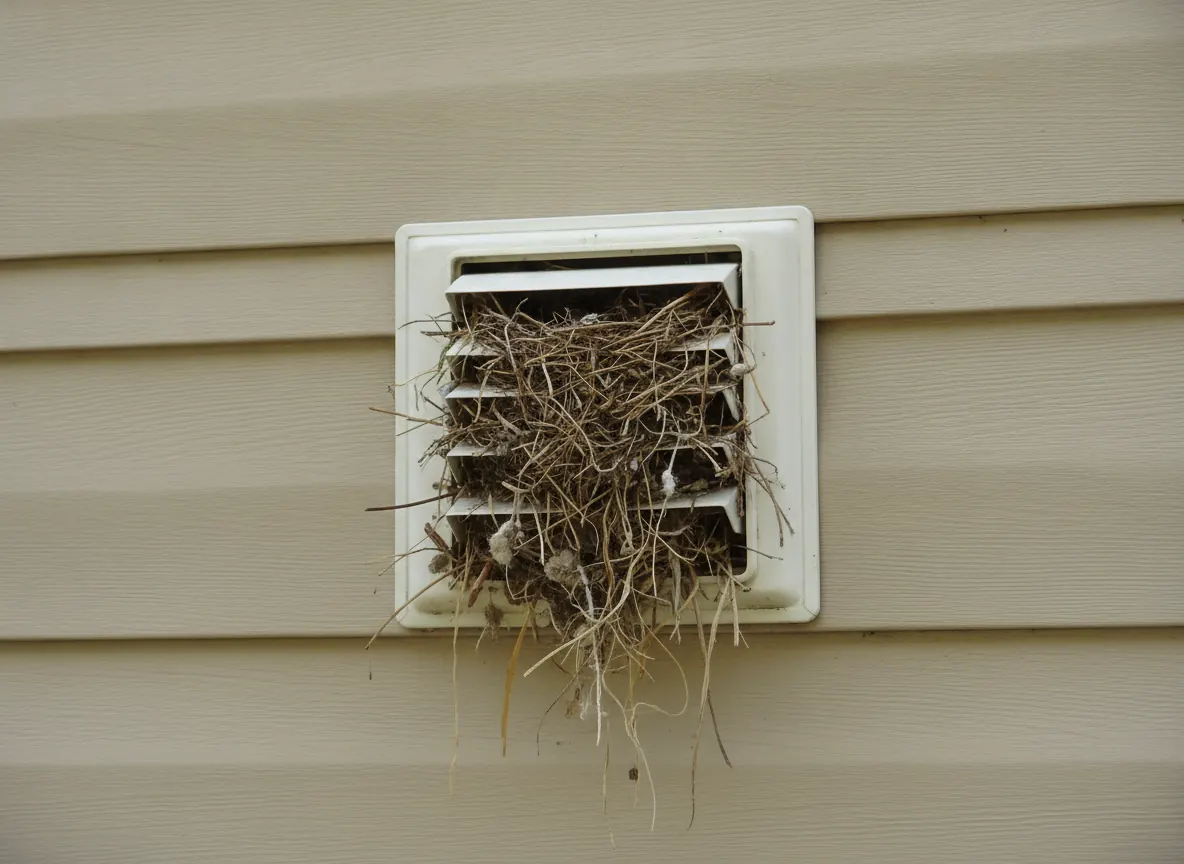
Signs a bird is nesting in your dryer vent
- Chirping, fluttering or scratching from the wall behind the dryer, often loudest in the morning.
- Twigs, grass, feathers or droppings around the outside vent hood.
- A vent flap that stays propped open instead of falling shut when the dryer is off.
- Birds flying in and out of the hood, sometimes carrying nesting material.
- Loads that take longer than normal to dry, or a laundry room that feels warmer than it should.
That last sign matters most. The U.S. Consumer Product Safety Commission (CPSC) says that if clothing is still damp at the end of a typical cycle, or drying takes longer than normal, "this may be a sign that the lint screen or the exhaust duct is blocked." CPSC also suggests checking the outside vent while the dryer runs "to make sure exhaust air is escaping." If you feel little or no airflow at the hood, something is in the way. For more warning signs, see 7 signs your dryer vent is clogged.
Is a bird nest in a dryer vent a fire hazard?
A nest is a plug of dry, combustible material sitting in a hot exhaust path. CPSC explains that "lint can block the flow of air, cause excessive heat build-up, and result in a fire in some dryers." A nest blocks airflow in the same way, and it traps lint behind it.
Animals in vents have caused real fires locally. In 2017, ABC 33/40 reported two recent Hoover fires linked to clothes dryers. In one of them, according to a Hoover fire spokesperson quoted in the story, "a squirrel crawled through an outside vent and died, igniting a fire." That case involved a squirrel, not a bird, but the lesson is the same: anything that blocks the vent stops hot air from leaving.
The national numbers point the same way. The U.S. Fire Administration (USFA), using 2008–2010 data, estimated 2,900 clothes dryer fires in residential buildings each year and found that "failure to clean (34 percent) was the leading factor." There is no need to panic. Just don't keep running the dryer for weeks once you know the vent is blocked. You can read more in our dryer fire statistics guide.
Identify the species first: what federal rules say
Before anyone removes a nest, it helps to know which bird built it. Federal law treats species very differently.
- Protected native birds. The U.S. Fish and Wildlife Service (USFWS) says that for birds protected under the Migratory Bird Treaty Act (MBTA), "it is illegal to destroy a nest that has eggs or chicks in it." If a native species has an active nest in your vent, you may need to wait until the young have left, or a permit may be required.
- House sparrows and starlings. USFWS's published list of species the MBTA does not apply to includes Passeridae, the Old World sparrows such as the house (English) sparrow, and Sturnidae, the starlings (Federal Register, July 31, 2023). These nonnative birds are frequent vent nesters, and the MBTA does not protect them.
These are federal rules. State and local rules can also apply, so check before acting if you are unsure. Snap a photo of the bird from a distance, or listen for chicks, and share what you see when you request a quote. A technician can then plan the timing: clear an empty or unprotected nest right away, or come back after the young of a protected species have fledged. This is general information, not legal advice.
How dryer vent bird nest removal typically works
Every company has its own method, but a typical birds in dryer vent removal visit looks something like this:
Inspect and confirm
The technician checks the exterior hood and the run, often with a camera, to see where the nest sits and whether eggs or chicks are present.
Remove the nest
Nesting material is pulled out by hand at the hood and then cleared from deeper in the duct with rotary brushes and a vacuum, usually working from the dryer end, the outside end or both.
Clean the whole run
Nests trap lint, so the full duct is typically cleaned rather than just the last few feet. See dryer vent cleaning for what that involves.
Check the termination
A torn flap, missing louvers or a hood that no longer closes is how the bird got in. The technician will usually recommend repairing or replacing the cap.
Test airflow
Many technicians take an airflow reading at the end so you can see the vent is clear.
Avoid reaching deep into the vent yourself or poking it with a stick. Nesting material can get pushed further down the duct, and second-floor and roof vents add ladder risk. Our bird nest removal page covers the service in more detail.
What does it cost?
| Item | Typical range |
|---|---|
| Bird nest or pest removal | $120–$400 |
| Dryer vent cleaning, overall | about $104–$188 (HomeAdvisor avg about $145; full range $75–$340) |
| Roof vent | $150–$300 |
| Minor repair | $75–$150 |
Typical national ranges from HomeAdvisor (2026), Fixr (2025) and Bob Vila (2024) — estimates, not quotes. Your real price depends on vent length, number of stories, roof access and the condition of the duct and cap. More detail is on our dryer vent cleaning cost page.
How to keep birds out of your dryer vent (the code-correct way)
The first idea many people have is to cover the vent with mesh. Don't. The International Residential Code, which Alabama has adopted with amendments, says exhaust duct terminations "shall be equipped with a backdraft damper" and that "screens shall not be installed at the duct termination." Mesh catches lint, the lint builds up into a mat, and the vent ends up as blocked as it was with the nest.
Prevention that works with the code instead:
- A working damper cap. A louvered or flapper-style vent cap with a backdraft damper opens when the dryer pushes air out and falls shut when it stops. That closed flap is what keeps birds out. Our dryer vent cover replacement page explains the options.
- Check that the flap closes. Lint buildup, paint or a bent hinge can hold a damper open, and an open flap is an invitation. Look at it with the dryer off a few times a year.
- Regular cleaning. A clean vent lets the damper move freely. NFPA and GE say at least once a year, and some manufacturers say every one to two years. See how often to clean your dryer vent.
- Act early in the season. Fixing a broken cap before spring nesting starts is simpler than dealing with an active nest.
Quick takeaway: identify the bird, keep the dryer off if airflow is blocked, have the nest and lint cleared, and replace a broken cap with a code-compliant damper cap. No screens or mesh at the termination.
Get quotes for bird nest removal in the Birmingham area
Birmingham Dryer Vent Cleaning is a free quote service. We connect Birmingham-area homeowners with independent local dryer vent cleaning companies for free, no-obligation quotes. Tell us what you are seeing at the vent, whether it is a first-floor wall vent or a roof or second-story vent, and include a photo if you can. Request your free quote and we usually reply the same day.